> For the complete documentation index, see [llms.txt](https://www.hardbreak.wiki/llms.txt). Markdown versions of documentation pages are available by appending `.md` to page URLs; this page is available as [Markdown](https://www.hardbreak.wiki/hardware-hacking/analyze-firmware.md).
# Analyze Firmware
After you successfully obtained a firmware dump, it's time to analyze its content.
## **Quick wins**
binwalk is the goto option for quickly analyzing your firmware
* Identify data
* `binwalk firmware.bin` : will give you an overview which contents are found in the dump
* **Example Output:**
```bash
DECIMAL HEXADECIMAL DESCRIPTION
--------------------------------------------------------------------------------
0 0x0 U-Boot bootloader image, header size: 64 bytes, load address: 0x80800000, entry point: 0x80800000, CRC32: 0xFFFFFFFF
64 0x40 LZMA compressed data, properties: 0x5D, dictionary size: 8388608 bytes, uncompressed size: 524288 bytes
1024 0x400 Linux kernel ARM boot executable zImage (little-endian)
1048576 0x100000 Squashfs filesystem, little endian, version 4.0, compression: lzma, size: 262144 bytes, 1198 inodes, blocksize: 131072 bytes, created: Mon Jan 1 00:00:00 2024
```
* Extract Firmware
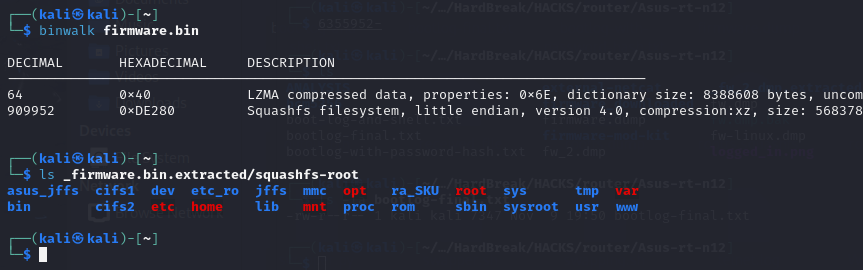
* `binwalk -e firmware.bin` : will try to automatically extract all content => will often give us full root-filesystem.
* Example:
Example extraction of a firmware
* Entropy Analyiss
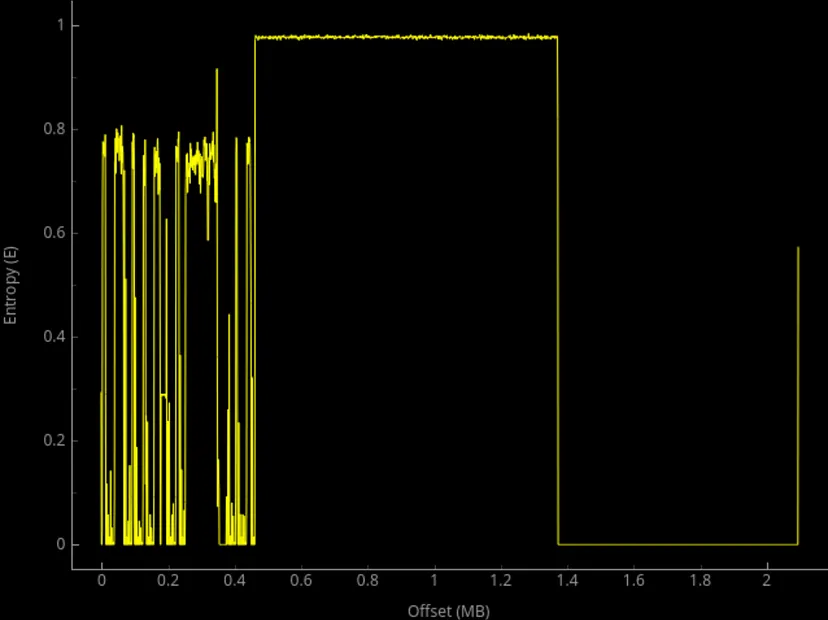
* `binwalk -E firmware.bin`This will give us the entropy of the firmware
* Note: parts of very high entropy can be sign for compression or encryption being used.
* Example Output:
Here we see a blob which might be encrypted or compressed